"I like Ike, you like Ike, everybody likes Ike for President!"

The Museum of the Moving Image and Nerve present the 20 best political ads of all time. A few of my favorites below.

Ike for President, 1952


"Mrs. JFK", 1960, En Espanol


"Wassup," 2008 (preceded by original commercial)


"The Bear", 1984 (Ronald Reagan faces off against a bear)


"Peace Little Girl (Daisy)", 1964


Read the full, interesting, and funny article here.

"A goodly number of senators, even of my own party, have shown about as much backbone as so many angleworms."


An interview with Teddy Roosevelt, on his 150th birthday:

"Q. Does (McCain's) vow to give Joe the Plumber a tax break remind you of Reaganomics?

A. This is merely the plan, already tested and found wanting, of giving prosperity to the big men on top, and trusting to their mercy to let something leak through to the mass of their countrymen below — which, in effect, means that there shall be no attempt to regulate the ferocious scramble in which greed and cunning reap the largest rewards."


Make Your Halloween Costume as Historically Accurate as Possible!


Consult the History Channel's guide to Halloween costumes! They've got a new series of video up that tours popular costume eras, like antebellum South and the 1920s and historical figures such as Marie Antoinette and George Washington.

Tony Perrotett (?) takes somewhat cheesy costumes, points out what is historically accurate about them, and offers advice to take them over the history-nerd top. For Marie Antoinette, he suggests using the poor hygiene of the 18th century to your advantage. "So to be really authentic for your Halloween party, don't brush your teeth for two weeks beforehand."

Awesome.

History.com: Halloween Costumes

China in 2008? No, New York City in 1858.


"THE milk was marketed as pure and wholesome, and it looked fine to the naked eye. How were the mothers to know they were poisoning their babies? They had paid good money for it on the open market. It would take thousands of sick children before lawmakers did anything to stop it...


"China in 2008? No, New York City in 1858.

"Adulteration on such a scandalous scale occurs in societies with a toxic combination of characteristics: a fast-growing capitalist economy coupled with a government unable or unwilling to regulate the food supply. In such get-rich-quick societies, there is a huge temptation to tamper with food, particularly when margins are low. The rewards are instant, and it’s not always easy for consumers to detect the difference between the pure and the doctored — particularly with a substance like milk, which we have been taught to trust implicitly.


"In the end, New York milk was cleaned up. It took stronger food laws, better policing, the advent of pasteurization and the passage of the Food and Drug Act in 1906, 50 years after the worst of swill milk. Above all, it took decades, not months or years. China faces many more food scandals — to add to recent alarms like pesticide-laced dumplings and lard made from sewage — before it reaches the point where its citizens can routinely trust what they eat...China’s present is America’s past."


Excerpted from The Swill Is Gone New York Times September 29th


Also, read the original articles on swill milk in the New York Times Archives

Google, Keeper of all Knowledge!!

I recently discovered Google Books, a searchable collection of public domain books, available to download for free!! I just got a copy of How to Mix Drinks: A Bartender's Guide, which was the first bartending book ever published. This book is incredibly hard to find, and reprints are upwards of $50.

But I got it from Google, for FREE! This is an incredible resource for historians.

From Google:

"This is a digital copy of a book that was preserved for generations on library shelves before it was carefully scanned by Google as part of a project to make the world’s books discoverable online.

...Public domain books are our gateways to the past, representing a wealth of history, culture and knowledge that’s often difficult to discover.

Marks, notations and other marginalia present in the original volume will appear in this file - a reminder of this book’s long journey from the publisher to a library and finally to you."

I think that's really nice.

Google Book Search

Quite possibly the Most Depressing Thing You'll Read Today

Titanic survivor sells mementos to pay for care.


"Rescued from the bitterly cold Atlantic on that April 1912 night, Dean, her 2-year-old brother and her mother were taken to New York with nothing but the clothes on their backs. Before returning home to England, they were given a small wicker suitcase of donated clothing, a gift from New Yorkers to help them rebuild their lives...

""I am not able to live in my home anymore," Dean was quoted as telling the Southern Daily Echo newspaper. "I am selling it all now because I have to pay these nursing home fees and am selling anything that I think might fetch some money."

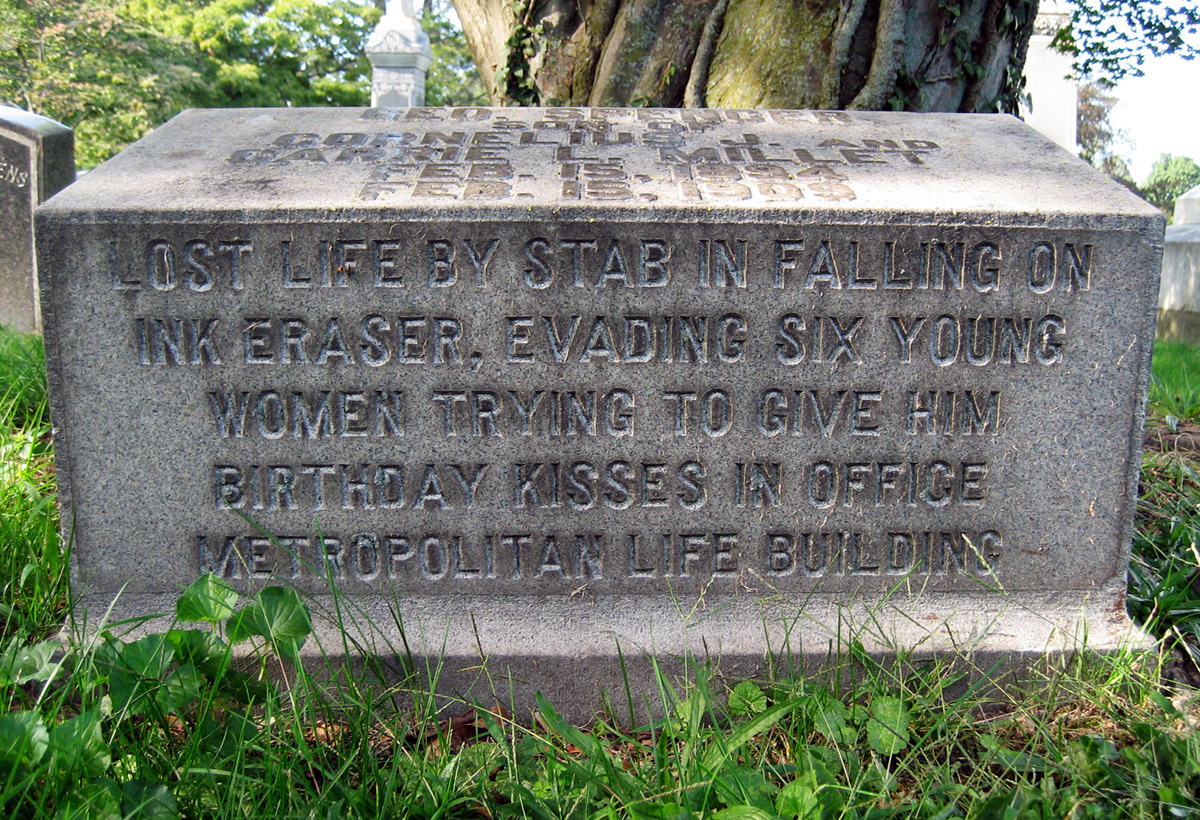
"LOST LIFE BY STAB IN FALLING ON INK ERASER, EVADING SIX YOUNG WOMEN TRYING TO GIVE HIM BIRTHDAY KISSES"


This link comes from the ever-connected Dj Bryan. Filmaker "pes" recounts his wanderings in Woodlawn cemetary in the Brox, home to the grave of Herman Mellville and (apparently) a band of wild coyotes.

Most interestingly, he talks about this tombstone inscription:

"LOST LIFE BY STAB IN FALLING ON
INK ERASER, EVADING SIX YOUNG
WOMEN TRYING TO GIVE HIM
BIRTHDAY KISSES IN OFFICE
METROPOLITAN LIFE BUILDING"

This is whar an ink eraser looks like:

From New York Times article from February 16, 1909:

"Yesterday he came down and remarked that it was the anniversary of the wreck of the Maine. He explained that he knew it because the ship had been blown up on his birthday and that he was 15 yesterday.At once the girls began to tease him. They told him that on such an occasion he desereved a kiss, and every one of them vowed that as soon as office hours were over she would kiss him once for every year that he had lived. He laughingly declared that not a girl should get near him, and was teased about it all day.As 4:30 o'clock came, and the boy's work was over, the girls made a rush for him. They tried to hem him in, and he tried to break their line. Suddenly he reeled and feel, crying as he did so."I'm stabbed!""

The whole article is worth a read: http://www.cartoonbrew.com/wp-content/uploads/inkeraserstabbing_nytimes1.pdf

And on a side note, the New York Times has its entire archives online, starting from the 1850s.

The Devil in the White City Dinner Party: Recipes!


The final menu:

Soup
Creme de Celeri

Hors D'oeuvres
Peach and Almond Salad; Olives

Refeve
Filet de Beouf aux Champignons
Haricots Verts
Pommes Parisiennes
Sorbet
Sorbet au Kirsch
Cigarettes

Roti
Roti de Carnard
Salade de Laitue

Dessert
Ginger Ice Cream
Bon-Bons; Assorted Fruit

Fromages
Roquefort et Camembert

Coffee, Cigars
Absinthe

All in all, the meal took three hours to devour.

Due to time and budget constraints, I wasn't able to pick out a wine for each course. I asked my guests to bring a boozey donation for the group. I did supply Kubler Absinthe for after dinner drinks, purchased at Lenell's in Redhook.

The cheeses came from Murray's; the Roquefort was a little too pungent for my taste, but the guests enjoyed it. The Camembert was buttery and delicious, and it was made in upstate New York.

The bon-bons were pralines from La Maison du Chocolate. There is actually a period appropriate chocolatier in New York, Debauve and Gallais. In fact, they were the first chocolatier ever, their first patron being Marie Antoinette. Their bon bons, however, were well out of my price range.

Coffee came from the always delicious Empire Coffee and Tea on 42nd and 9th.

The cigars and cigarettes came from J&R Cigar on 46th and 5th, a high quality shop with an inexpensive, hand-rolled, house brand; and good deals on name brand products. The Cigarettes were 100% tobacco Nat Sherman lights. The cigarette break in the middle of the meal was delightful; we all ajurned to my roof which has a view of Manhattan. Smoking cigars, sipping cocktails and talking post meal was also an exquisite experience.

A full list of the recipes I used are below. Many of them came from my own head, but I often consulted several different sources to create them. I have listed those resources in parenthesis.


Crème of Celery Soup
(The Epicurean: Part 1; foodnetwork.com)

20-25 ribs of celery
2 cups chicken stock or broth
1tablespoon sugar
1tsp fresh grated nutmeg
1 tsp salt
1 tsp pepper
2 tablespoons flour
3 tablespoons butter

De-rib celery with a vegetable peeler. Dice and blanch until soft. Drain all but 1 ½ cups liquid; add sugar, nutmeg, salt and pepper. Puree in a blender or food processor.
Create a roux with butter and flour, whisk in chicken broth. Simmer until slightly thickened; whisk in celery puree. Season to taste.


Peach and Almond Salad
(Feeding America)

2 ½ cups sliced peaches
½ cup slivered Almonds
1 cup sugar
3 egg yolks
Juice of 2 lemons

Boil sugar with ½ cup water for five minutes. Whisk egg yolks until frothy, then slowly drizzle in sugar syrup, whisking constantly. Return to medium heat, stirring constantly until it is thick enough to coat the back of a spoon. Let cool.

Pour a little of this dressing into a bowl; cut up peaches and add to the bowl, adding enough dressing to cover the peach slices. The sugar will prevent the peaches from oxidizing. Add almonds and mix. Serve with dressing to taste.


The recipes for Filet de Beouf aux Champignons and Pommes Parisiennes came directly from Julia Child's Mastering the Art of French Cooking.

The green beans were blanched until bright green, drained in a strainer rinsed in cold water to stop cooking. Then the were sauteed with butter and salt.


Kirsch Sorbet
(the chocolate traveler: http://www.chocolatetradingco.com/magazine.asp?section=28&id=42)

½ cup confectioners sugar
½ cup skim milk
½ cup heavy whipping cream
1 cup water
¼ cup + 1/8 cup kirschwasser

Bring the milk and sugar to a boil and simmer until the sugar has dissolved. Remove fromheat and stir in the water. Add the kirsch to taste. Pour into ice cream maker and make as usual. Transfer the ice cream to an airtight container and freeze until ready to eat. Garnish with cherry preserves.


Roti de Carnard
(Mastering the Art of French Cooking, page 272; Martha Stewart Everyday Food Magazine Herb Rubbed Turkey)

1 6lb Duckling
Celery
Onions
Parsley

Brine:
1 gallon water
1 cup sugar (I used maple syrup)
1 cup salt
2 bay leaves
5 peppercorns

Bring the brine to a boil in a large stockpot, then cool to room temperature. A few trays of ice cubes can be added. It is important the brine is cool so that the duck does not begin to stew in the hot liquid.

Remove the ducking from it's wrapping, and pull the neck and “gutbag” from the cavity. Set these aside in a saucepan. Soak the duck in the brine overnight in the refrigerator.

Add celery, an onions, bay leaves, peppercorns, and salt to the neck and guts in the saucepan. Cover with water and bring to a boil; turn down heat and simmer about 20 minutes. Strain and save liquid, save in refrigerator.

Before roasting, remove the ducking from the brine. Rinse thoroughly, including the inside cavity, and pat dry. Trim fat flaps from front and back of duck and stuff inside cavity. Fill cavity with parsley, a quartered onion, and celery. Sew or spear shut. Rub duckling with olive oil, salt, pepper, and Herbs de Provence.

Preheat oven to 425 degrees. Roast duck 15 minutes, then reduce heat to 350. A 6 pound duck will need to cook about 2 hours, until the juices are rosy (medium) or clear (well done).
Remove duck from roasting pan and turn breast side down on a platter. Let rest for about 10 minutes. Ladled up juices from pan, avoiding the fat, and add to duck stuck made the night before. Add wine to taste and bring to a hard boil. Boil until sauce is slightly thickened.

Carve duck and serve with sauce.


Salade de laitue
(Feeding America)

1 head lettuce
2 tablespoons oil
4 tablespoons white wine (or rice wine) vinegar
1 tsp pepper
1 tsp salt
Wash and dry lettuce. Rip into bite-size pieces.
Combine dressing ingredients in a container with a lid. Shake to combine. Pour over lettuce and toss.


Ginger ice cream
(foodnetwork.com)

3 cups heavy cream
1 cup skim milk
1/4 cup grated fresh ginger
Pinch salt
8 egg yolks
3/4 cup sugar
1 tsp Vanilla


In a large, heavy saucepan, combine the cream, milk, ginger, and salt over medium heat and simmer for 20 minutes.

In a large bowl, combine the egg yolks, sugar and vanilla. Whisk until pale yellow in color and frothy. Ladle 1/2 cup of the hot cream mixture into the eggs and whisk well to combine. Stir the egg mixture into the hot cream mixture and cook over low heat, stirring constantly to prevent sticking, until thick enough to coat the back of a spoon, 3 to 5 minutes. Strain into a large clean bowl through a fine mesh strainer, pressing with the back of a large spoon to extract as much liquid as possible. Cover tightly and place in the refrigerator until well chilled, at least 3 hours.
Pour the custard into the bowl of an ice cream maker, and freeze according to manufacturer's instructions. Transfer the ice cream to an airtight container and freeze until ready to eat.

The Devil in the White Dinner Party: Photos!


The DinWCDP was this past weekend, and it was a resounding success. If there's one thing people love, it's decadence.

Here are a few photos from the event (more to come). I'm going to have a complete menu and accompanying recipes up in a few days.

"Elitist 17th Century Jesus Freaks"

One of my favorite essayists, Sarah Vowell, has a new book out, The Wordy Shipmates, on the puritanical founders of America. Vowell's history writing is the best: she focuses on the personal and the emotional, which I believe allows the reader a better understanding of historical events.

She's also hilarious. Here's her interview on the Daily Show.


UPDATE: she's also in Time Out New York this week:
Sarah Vowell: Puritans were so Punk Rock.

WTF: Union Soldier Shot at Reenactment


And apparently, it's happened before:

"'These things happen,' said Kay Jorgensen, editor of Civil War News, a Vermont monthly reporting historical happenings and preservation efforts. In 1998, a re-enactor was shot in the neck at a 135th anniversary event at Gettysburg (medical researchers used the opportunity to compare his treatment with that of veterans wounded in the original carnage). Another re-enactor was shot in the foot in August 2008, also at Gettysburg."

Putting a bullet in a civil war gun is no small task. It doesn't happen by accident. Some one out there was trying to kill somebody.

A Rebel Soldier’s Aim Is Still Pretty Accurate, but His Timing Is Off (NYTimes)