Showing posts with label death. Show all posts

The Most Beautiful Suicide and a Traveling House

I've been so preoccupied with other projects that I haven't had time to share a few links that have come across my desk:


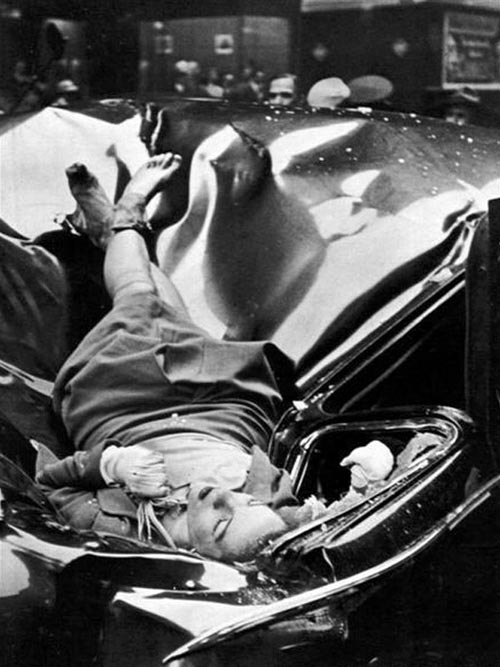
The most beautiful suicide, a photograph of a woman who jumped from the Empire State building in 1947.

In the same line, L'Inconnue, an unidentified woman who was found dead in the Seine. People found her visage so beautiful, that it became a fashion to hang her death mask on the parlour wall.

And finally, Ulysses S. Grant's birthplace toured the country following his death.

Two "Fun" Things to do the Next Time You're in Cleveland


The Cleveland Police Museum:

"Various fascinating and often grisly artifacts from Cleveland's crime history. The star of the exhibits is the corner devoted to the infamous Torso Murders of the 1930s, generally thought to be the first recognized serial killings in the United States. Particularly scary-cool are the four painted and bewigged plaster casts of the faces of four unidentified Torso Murder Victims. These were shown in a little out-of-the-way booth at the 1937 Great Lakes Exposition in Cleveland, in the hopes that someone might recognize them. No one did. Now they're a little worse for the wear, but all the more creepy for it." (from RoadsideAmerica.com)


The Percy Skuy Collection on the History of Contraception, at CWRU's Dittrick Medical History Center.

"This unique collection includes a wide range of contraception items, prototypes, and manufacturing devices...The world's most comprehensive collection of historical contraceptive devices, numbering over 650 artifacts. The permanent exhibit will examine the interface between contraceptive development and innovations in science and technology, and explore the impact of changes in contraception upon daily life and public policy." (Dittrick Medical History Center Website)

You can also listen to a lecture online: Uncovering the Lost History of Contracpetives in America

Haunted Houses and Carbon Monoxide

This account of a haunted house, printed in the American Journal of Ophthalmology in 1921, came to my attention from the Halloween episode of This American Life.

The haunting began in November, after this family moved into a ""large, rambling, high-studded house, built around 1870, and much out of repair."

An excerpt:

"That morning after breakfast, as was my usual custom, I sent for the children’s nurse, a Scotch woman who had lived with me for several years. She looked worn out, and when I asked how the children had slept she burst out with, 'It has been a most terrible night. This house is haunted.’"

"I laughingly told her that that was the most ridiculous thing I had ever heard. 'I would have said the same thing three months ago,’ she answered, 'but I have had such experiences that I am now convinced of it, and everyone in the house has had experiences too.’ She said that after being in the house two or three days, things had begun to happen. She had not told me before, as she and the rest of the household had made up their minds that I ought not to be disturbed about it. 'But last night,’ she continued, 'when the children were attacked, it became my duty to let you know at once.

"'While you were at the opera,’ she went on, 'about half past eight, B woke up and ran screaming through the hall to my room, "Don’t let that big fat man touch me." He was terrified. It took Fraulein and me until ten o’clock to calm him. He slept the rest of the night with me, in my room. Fraulein slept in B’s bed, besides G Jr., to protect him. "G Jr. did not wake up all night but the muscles of his face kept twitching, as if someone was continually pinching him. In the morning when he woke, he said indignantly to Fraulein, "Why have you been sitting on top of me?" And when she told him that she had not been sitting upon him, but had been in the bed next to him, he said, "No, you have been sitting on top of me, and you were awfully heavy, too."

"'Often in the evening, after the children have gone to bed, never until after dark and the lights are lighted, Fraulein and I may be laughing and talking, when all of a sudden we hear the heavy tread of an old man walking slowly and steadily along the hall on the floor above us. It has not been one of the servants, for I have often run up stairs to see, and I have found the whole upper story of the house in darkness and empty. Sometimes as I walk along the hall I feel as if someone was following me, going to touch me. You cannot understand it if you have not experienced it, but it is real.

"Much amused as we were by all these tales, we nevertheless felt as if there was a serious aspect to it. Why had all the servants whom we had had for several years, gone practically mad all of a sudden? We began to trace back the history of the house. The last occupants we found had exactly the same experiences as ourselves, with the exception that they stated that some of them had seen creeping around their beds visions clad in purple and white. Going back still further, we learned that almost everyone had felt ill and had been under the doctor’s care, although nothing very definite had been found the matter with them.

"...Mr. S, came at once to our house...He found the furnace in a very bad condition, the combustion being imperfect, the fumes, instead of going up the chimney, were pouring gases of carbon monoxide into our rooms. He advised us not to let the children sleep in the house another night. If they did, he said we might find in the morning that some one of them would never wake again."

The family moved out of the house and never experienced hauntings again. It turns out that all of the symptoms of the haunting--the visions, noises, listlessness, and feeling as though someone where sitting on their chest--are all symptoms of carbon monoxide poisoning. The website where I found the article in its entirety points out that "...Carbon monoxide is still the most common cause of toxic poisonings and deaths in America, it is probably still a common cause of haunted houses."

Read the full article.
This American Life: And the Call was Coming from the Basement

Make Gertrude Tredwell your Facebook Friend!


Recently, I visited the Merchant's House Museum on East 4th street here in New York. The house, built in 1832, is exceptional because it contains all of the original furnishings and possessions of the family that lived there for almost 100 years. How can such a thing happen? Well, the mother and father of the family both died in the 1860s; the three youngest daughters, unmarried, lived out the rest of their lives in the home, and never changed a thing after their parent's death. The beds had been moved in to the bedrooms the in 30's and had never moved again.

That is a little weird, right?

Gertrude, the youngest daughter, died in the 1930s. The house was recognized for the time capsule that it is and was almost immediately purchased and opened to the public.


I had been at the museum once before, at a funeral reenactment several Halloweens ago. They upped the anty on other funeral reenactments I had seen by including a wax corpse.


Additionally, should you visit, take note of the house next door.

"If there is a three-dimensional, bricks-and-mortar definition of forlorn, it is the abandoned Samuel Tredwell Skidmore House, which has stood at 37 East Fourth Street since 1845 - ever more tenuously in recent years.

"This sorry state is no accident...but rather a result of deliberate "demolition by neglect" by the owner, identified as the estate of Sol Goldman.

"What makes the decay of the Skidmore House so striking is the existence just 75 feet away, at 29 East Fourth Street, of the Merchant's House Museum, an exquisitely maintained landmark that was built in 1832 and occupied three years later by Seabury Tredwell, Skidmore's cousin once removed, and his large family.

"Margaret Halsey Gardiner, the executive director of the Merchant's House Museum, says she has watched despairingly as the neighboring Skidmore House fell apart. Occasionally, she got inside.

"In the early 1990's, she said, the house was still "manageably reparable" and possessed a remarkable number of 19th-century features: shutters, doorjambs, doorknobs, floorboards, a stairway balustrade with newel post and a lantern in the front hall.

"With each passing year and each fire and each wall collapse, she said, more of these elements vanished, some carted off by workers, some appropriated by neighbors.

"The heartbreaking final straw, Ms. Gardiner said, was the disappearance five or six months ago of the original bell pull at the front door. It still said "Skidmore," 123 years after Samuel Tredwell Skidmore died in that house.

" 'Skidmore,' " she marveled. " 'Skidmore!' There it was.

"'I should have stolen it myself.'"

Read the full New York Times article; a ruling was made in 2004 that the owner must preserve the Skidmore house, a historical landmark, but it still looks like shit.

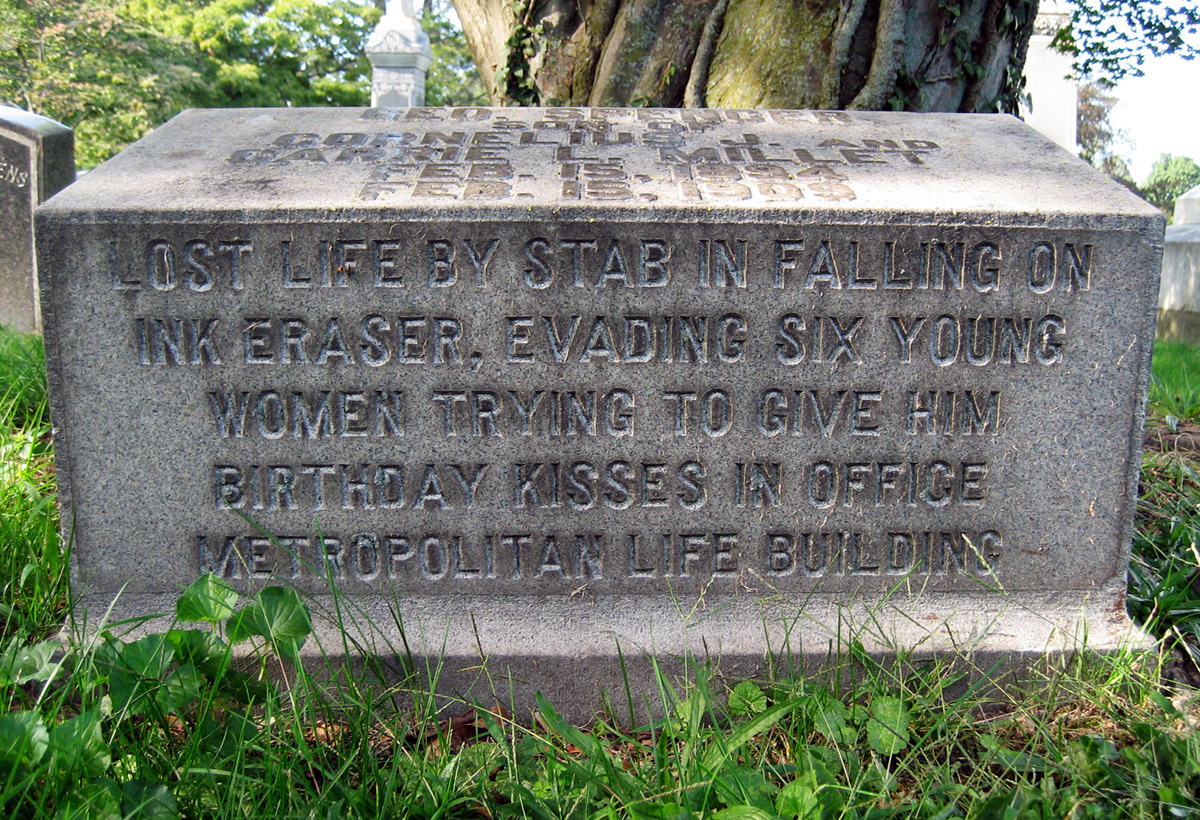
"LOST LIFE BY STAB IN FALLING ON INK ERASER, EVADING SIX YOUNG WOMEN TRYING TO GIVE HIM BIRTHDAY KISSES"


This link comes from the ever-connected Dj Bryan. Filmaker "pes" recounts his wanderings in Woodlawn cemetary in the Brox, home to the grave of Herman Mellville and (apparently) a band of wild coyotes.

Most interestingly, he talks about this tombstone inscription:

"LOST LIFE BY STAB IN FALLING ON
INK ERASER, EVADING SIX YOUNG
WOMEN TRYING TO GIVE HIM
BIRTHDAY KISSES IN OFFICE
METROPOLITAN LIFE BUILDING"

This is whar an ink eraser looks like:

From New York Times article from February 16, 1909:

"Yesterday he came down and remarked that it was the anniversary of the wreck of the Maine. He explained that he knew it because the ship had been blown up on his birthday and that he was 15 yesterday.At once the girls began to tease him. They told him that on such an occasion he desereved a kiss, and every one of them vowed that as soon as office hours were over she would kiss him once for every year that he had lived. He laughingly declared that not a girl should get near him, and was teased about it all day.As 4:30 o'clock came, and the boy's work was over, the girls made a rush for him. They tried to hem him in, and he tried to break their line. Suddenly he reeled and feel, crying as he did so."I'm stabbed!""

The whole article is worth a read: http://www.cartoonbrew.com/wp-content/uploads/inkeraserstabbing_nytimes1.pdf

And on a side note, the New York Times has its entire archives online, starting from the 1850s.

I Want to Talk About Dead People for Awhile.


About two years ago, an insane asylum in Portland, Oregon was being cleaned out. The creamated remains of 5,000 unidentified patients were discovered “tucked away in a closet.”

It seemed to be fairly common in 19th c. insane asylums that many of the inmates were without relatives, names, or even identities. At The Ridges, in Athens, Ohio, many inmates were buried in anonymous graves, their tombs marked only by a number.

These particular remains were sealed in copper containers that corroded over time, creating fascinating patterns on the outside of the cans. Artist David Maisel has been photographing the remains. The individuality of the “portraits” he takes seems to give the inmates the identity they have been denied in death.


Further reading:

Wikipedia: Athens Lunatic Asylum
Boing Boing:
Cremated remains of 5,000 mental patients discovered in old Oregon sanatorium

Obligatory Oscars Post, and What It has to do with History


Marie Antoinette won a much deserved Oscar for Best Costume Design. While I found the film vapid, the costumes were both incredibly accurate and delightfully inaccurate, with contemporary touches such as a whimsically placed Converse All-Star.


The luminous Catherine Deneuve was wearing a dress from my favorite spring couture collection, John Paul Gaultier, which was based on the Virgin Mary. She looked elegant even wearing a dress with a stabby heart and glitter blood.


The Death Montage gets me every time. That’s when the recap everyone involved in the Industry that has passed away in the last year. I always tear up. And then I think about how strange it is, to have these moving images of people that no longer exist. And how after I am gone, there will be images of myself that what still exist long after my physical body. I don’t know what to make of that.

At least, like The Fug Girls, I'm consistantly relieved to find out Gene Wilder is not dead.

And Gael Garcia Bernal makes my heart hurt. Sigh.