Showing posts with label new york. Show all posts

Some Drunks Give the History of St.Patrick's Day

Busting out one of my favorite videos: I roamed the New York streets one St Patty's to find the true meaning of the occasion.


New York: 2008, 1978; 2009, 1609.


From The New York Times via DJ Bryan: Then/Now, a Series by David W. Dunlap

"The assignment in 1978 was simply to illustrate "The City Observed: New York," a guidebook to Manhattan by Paul Goldberger, who was then the architecture critic for The New York Times.

"My editors and I thought that pairing photos from then and now would be a graphic way to examine the phenomenon of urban churn that so defines this city. The series will visit a dozen or so neighborhoods, uptown and downtown, before the end of 2008. Each diptych tells its own tale, but the overall story is clear: It doesn't take much longer than a generation for New York to regenerate itself completely. "

It's well worth taking a look at this photo series. There is a cool flash application that allows you to use a slider to scrub back and forth between 2008 and 1978.

Also from the New York Times, this composite photos shows Manhattan Island in 2009 and a rendering of what it would have been like in 1609.


Come on Ride the Orphan Train!

My mom called me into the living room for this rather odd choice for a holiday feature on CNN: an interview with a gentleman who, as a young boy, was one of the many children shipped west from New York on the Orphan Train.

The Orphan Train was a social welfare organization, which from 1854-1929 took immigrant orphans off the streets of New York and relocated them to the west to work for wealthy families. Sometimes, there was a happy ending: the children were taken out of a toxic environment to a rural community where they thrived. But my impression is that, more often than not, the children were essentially slaves to their adoptive families. In fact, some argued that the Train would be a cure for slaves, since families who adopted an orphan would no long be in need of a black slaves. Children were carted out in front of wealthy families who selected the ones they wanted to take home.

The worst part is that many of the children were not actually orphans; the society did not extensively check into the backgrounds of the orphans they received. I read one story of a boy who was caught up in following a marching band and was separated from his mother; he was scooped up by Orphan Train workers and never saw his family again.

So watch the CNN special and let your heart be warmed. But also remember the children who never saw their families again.


Further Reading: The Battle for Christmas

MTA Unleashes 1930s Subway Cars Every Sunday

If you're in New York City, do not miss the chance to ride on a vintage 1930s subway car, complete with wicker seats and ceiling fans. The car is running everyone Sunday on the V line. You can see the schedule here.

If you're not in NYC right now, like me, you'll have to make do with this video on the experience. It's produced by my esteemed colleague Jonah Green.


I'm so shitty I missed this opportunity.

Would Anyone Like to Go Urban Camping? (A Brief History of Roosevelt Island)

I live near Roosevelt Island, a strip of land in the middle of the East River, between Manhattan and Queens. The Island has a rather rich an sordid history: at one time, built upon its grounds was a prison, a workhouse, an almshouse, a small-pox hospital, and an insane asylum. The latter was made famous by New York World reporter Nellie Bly. In an 1887 article, she went undercover as an insane woman to expose ill-treatment of the asylum's inmates. Today, the asylum building is a luxury condo.

You can see Roosevelt Island's various institutions in this 1903 Edison film. Also note that you can see the Queensborough Bridge in the process of being built--neat!


The Smallpox Hospital, on the south end of the island, still exists. After the smallpox epidemic was over, the building opened as a Nurse's School which closed its doors in the 1950s. The building has been abandoned since, and it's ruins are dramatically lit by the same lighting designer that illuminated the Statue of Liberty. You can get a good view of it from the Manhattan shoreline on the FDR.


I was fortunate enough to see the ruins up close. In 2008, Open House New York opened up South Point, the overgrown swath of land surrounding the ruins that has tentative plans to be turned into a park. Currently, it's locked up for all but special events. What's wonderful about South Point is that it feels wild--and it is. Unlike Olmstead's carefully constructed vision for Central Park, South Point is nature built from neglect. Walking through its center on a warm October evening, I could neither hear nor see the city. Woods open up to a grassy lawn, with breathtaking views of Manhattan and Queens on either side.

The space is ripe for an Urban Camping expedition.

I first went Urban Camping in Cleveland, on an empty lot on the city's west side that was once a teeming Civil War hospital. I wanted to draw attention to the neglected patch of land and increase the neighborhood's awareness of the history that took place on that unassuming lot. Myself and six friends camped out overnight: we built a campfire, cooked dinner and breakfast, told stories, played music. It felt positively rural--but all we had to do was look up to see Cleveland's gleaming skyline. Late in the night we were treated to a sky full of fireworks over Jacob's Field.

Southpoint is just right for the second installment of Urban Camping. The combination of the rural and urban is intoxicating. And the area has a rich history--in fact, in the Southpoint area quarantined smallpox victims were cared for in what Resident Physician William Kelly described as "a pile of poor wooden out houses on the banks of the river."

So would anyone be interested in joining me this summer? Additionally, is their anyone in the know who can recommend someone I can talk to about getting permissions for such an event? I'm going to put together a proposal this Spring.

Camp Out at Camp Cleveland (Urban Camping)- Tremont paper Article

Urban Camping Video

The Roosevelt Island Historical Society

The Duke's Motto

I first came across the play The Duke's Motto while writing a letter to my friend Tea. Tea works in a history museum in Ohio. She has the job of recreating a character in 1863, and I know from experience that long summer days talking about the battles of the Civil War can get boring and depressing. So I offered to send her letters as a "friend" in "New York City" in 1863 to add a little excitement to her day. Nerdery.

I scanned a July, 1863 edition of the New York Times to see what was going on the in the city. This was at the height of the Civil War--Gettysburg and Vicksburg both take place in early July. I found mention what seemed to be a wildly popular play called The Duke's Motto:

"The new play of the Duke's Motto continues to attract tremendous audiences at Niblo's."

"The Duke's Motto attracts good audiences, as it deserves to do, being by all odds the best constructed and best acted play now before the public."

The play was revived again in 1864, and in 1870 to large audiences and glowing reviews. An article from 1870, however, mentions that the play is "...complicated, obscure and improbable," but is saved by the talents of the lead actor, a Mr. Fletcher.

The play also included an acrobatic feet, in which the lead actor climbs a rope carrying a baby, and two songs that the article calls "stupid."

Then the play is revived again, 20 years later in 1883:

"Mr. Stetson has been digging rather deep of late into the graveyard of melodrama. After having unearthed those lively masterpieces of ghastly mimicry, "The Corsican Brothers" and "Monte Cristo," he has new brought to light 'The Duke's Motto.' It is, perhaps, needless to remark that all these plays are very bad plays.

"They were popular once upon a time, and they are still useful, apparently, for certain purposes. Yet it seems to us that Mr. Stetson might do better than revive this farrago of cheap nonsense called 'The Duke's Motto.' No one takes such a piece seriously to-day."

Ouch.

I noticed advertisements for The Duke's Motto plastered on a way in a period Civil War photo in the previously mentioned New York documentary. I've only found a copy ofthe novel The Duke's Motto, translated from the original French. But as soon as I find a script, anticipate a revival performance in my living room.


Happy Evacuation Day!

Today was an actual holiday, once more popular than the 4th of July, celebrating the day the British pulled out of New York City during the Revolutionary War.

This year was the 225th anniversary. And I missed it!!!! I had no idea it was going on. There were costumed reenactors!!! From the Minneapolis Star Tribune:

"A private reenactors group, the Brigade of the American Revolution, prepared a mock ceremony in which a British officer would give the key to New York City to one of Washington's officers.

That didn't actually happen in 1783, but the little drama was intended to symbolize the transfer of power that ended the Revolutionary War, two years after Washington's victory at Yorktown, Va., said park service spokesman Michael Callahan."

I love seeing things reenacted that never happened! Oh well...maybe next year.

Also, there are some commemorative lights in Jersey tonight, marking important Revolutionary War sites, including Fort Nonsense.


NYC Marks Evacuation Day (Minn. Star Tribune)


The Magdalene Asylum for Aged Prostitutes


Last night, I was watching the magnificent documentary, New York, with my roomates. We're on the second DVD, which covers from the 1840s-the Civil War. During the section on the 1863 draft riots, the narrator mentioned that there was damage done to the Magdalene Asylum for Aged Prostitutes. Of course that caught my attention. To the Internet!

I first decided to check the New York Times archives, and came across this article about Magdalene Asylums in Ireland, the topic of the film The Magdalene Sisters.

"The Magdalene Asylums were set up in the 19th century as a refuge for prostitutes and other so-called fallen women. Operated by the Sisters of the Good Shepherd and other orders of nuns, the asylums financed their operations by functioning as commercial laundries providing service to schools, prisons and other institutions across Ireland.

The asylums soon became places where families -- under pressure from the Catholic Church and the stringent code of morality in place -- could send daughters who, for whatever reason, had brought shame on them.

The women worked long hours and received no pay. They were required to pray virtually nonstop. If they were unwed mothers, their babies were put up for adoption or sent to orphanages. Many of the women were so cut off from the outside world that they never left the asylums, and lived and worked there until they died. "

The last of the Ireland asylums didn't close until 1996.

As far as period articles, I only came across this short article from 1867:


And then finally, this slightly more uplifting article about a modern home for aged sex workers in Mexico city:

"Elderly former prostitutes have found a refuge from their tough street lives in a Mexico City retirement home, a first in a country where deep-rooted machismo has little sympathy for aging sex workers.

The refuge, named Xochiquetzal after the Aztec goddess of beauty and love who was also the patron of prostitutes, houses 25 former sex workers over the age of 60.

Most were still working until recently, having no other source of income, often for just a few dollars a client."

More Googling revealed a few period sources on Magdalene Asylums in general, but nothing about the Asylum for Aged Prostitutes in New York. In the latter half of the 19th century, New York was a difficult place in which to build a life; I hope it was a place of some relief for women who had lived their lives on the streets.


Make Gertrude Tredwell your Facebook Friend!


Recently, I visited the Merchant's House Museum on East 4th street here in New York. The house, built in 1832, is exceptional because it contains all of the original furnishings and possessions of the family that lived there for almost 100 years. How can such a thing happen? Well, the mother and father of the family both died in the 1860s; the three youngest daughters, unmarried, lived out the rest of their lives in the home, and never changed a thing after their parent's death. The beds had been moved in to the bedrooms the in 30's and had never moved again.

That is a little weird, right?

Gertrude, the youngest daughter, died in the 1930s. The house was recognized for the time capsule that it is and was almost immediately purchased and opened to the public.


I had been at the museum once before, at a funeral reenactment several Halloweens ago. They upped the anty on other funeral reenactments I had seen by including a wax corpse.


Additionally, should you visit, take note of the house next door.

"If there is a three-dimensional, bricks-and-mortar definition of forlorn, it is the abandoned Samuel Tredwell Skidmore House, which has stood at 37 East Fourth Street since 1845 - ever more tenuously in recent years.

"This sorry state is no accident...but rather a result of deliberate "demolition by neglect" by the owner, identified as the estate of Sol Goldman.

"What makes the decay of the Skidmore House so striking is the existence just 75 feet away, at 29 East Fourth Street, of the Merchant's House Museum, an exquisitely maintained landmark that was built in 1832 and occupied three years later by Seabury Tredwell, Skidmore's cousin once removed, and his large family.

"Margaret Halsey Gardiner, the executive director of the Merchant's House Museum, says she has watched despairingly as the neighboring Skidmore House fell apart. Occasionally, she got inside.

"In the early 1990's, she said, the house was still "manageably reparable" and possessed a remarkable number of 19th-century features: shutters, doorjambs, doorknobs, floorboards, a stairway balustrade with newel post and a lantern in the front hall.

"With each passing year and each fire and each wall collapse, she said, more of these elements vanished, some carted off by workers, some appropriated by neighbors.

"The heartbreaking final straw, Ms. Gardiner said, was the disappearance five or six months ago of the original bell pull at the front door. It still said "Skidmore," 123 years after Samuel Tredwell Skidmore died in that house.

" 'Skidmore,' " she marveled. " 'Skidmore!' There it was.

"'I should have stolen it myself.'"

Read the full New York Times article; a ruling was made in 2004 that the owner must preserve the Skidmore house, a historical landmark, but it still looks like shit.

China in 2008? No, New York City in 1858.


"THE milk was marketed as pure and wholesome, and it looked fine to the naked eye. How were the mothers to know they were poisoning their babies? They had paid good money for it on the open market. It would take thousands of sick children before lawmakers did anything to stop it...


"China in 2008? No, New York City in 1858.

"Adulteration on such a scandalous scale occurs in societies with a toxic combination of characteristics: a fast-growing capitalist economy coupled with a government unable or unwilling to regulate the food supply. In such get-rich-quick societies, there is a huge temptation to tamper with food, particularly when margins are low. The rewards are instant, and it’s not always easy for consumers to detect the difference between the pure and the doctored — particularly with a substance like milk, which we have been taught to trust implicitly.


"In the end, New York milk was cleaned up. It took stronger food laws, better policing, the advent of pasteurization and the passage of the Food and Drug Act in 1906, 50 years after the worst of swill milk. Above all, it took decades, not months or years. China faces many more food scandals — to add to recent alarms like pesticide-laced dumplings and lard made from sewage — before it reaches the point where its citizens can routinely trust what they eat...China’s present is America’s past."


Excerpted from The Swill Is Gone New York Times September 29th


Also, read the original articles on swill milk in the New York Times Archives

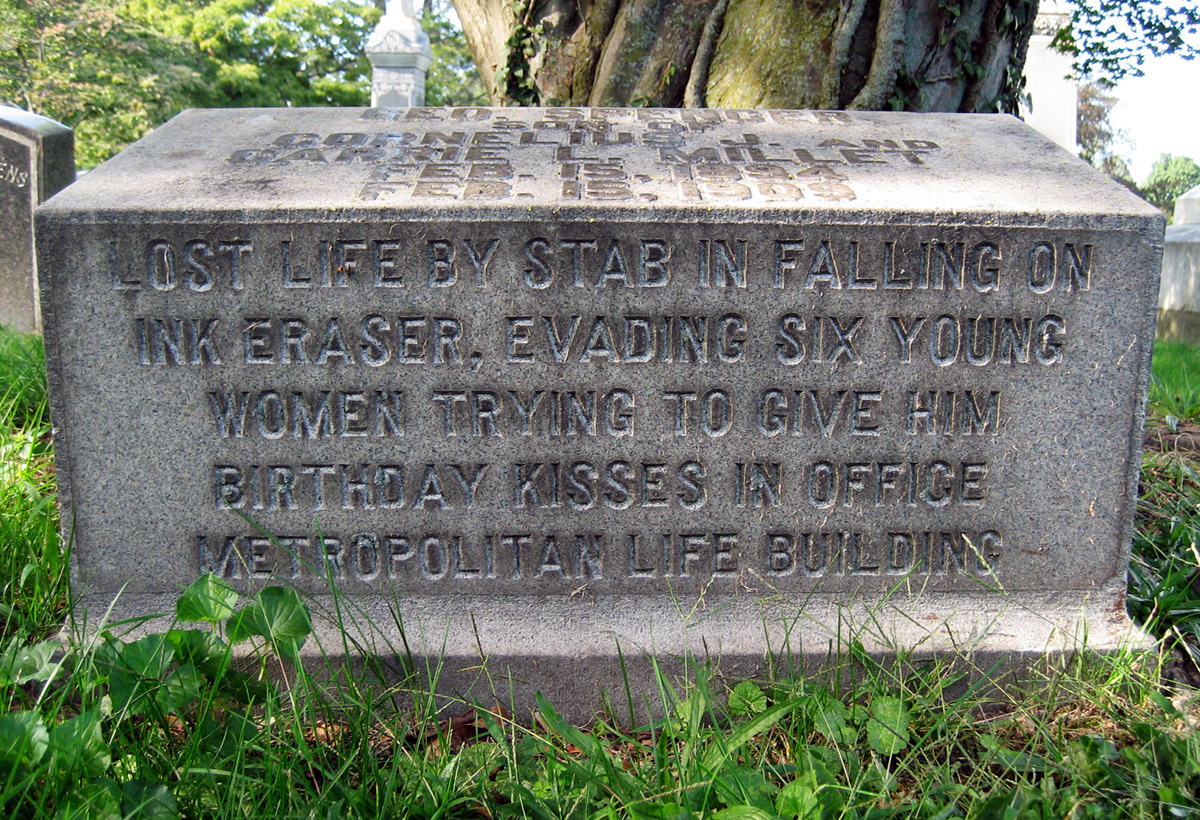
"LOST LIFE BY STAB IN FALLING ON INK ERASER, EVADING SIX YOUNG WOMEN TRYING TO GIVE HIM BIRTHDAY KISSES"


This link comes from the ever-connected Dj Bryan. Filmaker "pes" recounts his wanderings in Woodlawn cemetary in the Brox, home to the grave of Herman Mellville and (apparently) a band of wild coyotes.

Most interestingly, he talks about this tombstone inscription:

"LOST LIFE BY STAB IN FALLING ON
INK ERASER, EVADING SIX YOUNG
WOMEN TRYING TO GIVE HIM
BIRTHDAY KISSES IN OFFICE
METROPOLITAN LIFE BUILDING"

This is whar an ink eraser looks like:

From New York Times article from February 16, 1909:

"Yesterday he came down and remarked that it was the anniversary of the wreck of the Maine. He explained that he knew it because the ship had been blown up on his birthday and that he was 15 yesterday.At once the girls began to tease him. They told him that on such an occasion he desereved a kiss, and every one of them vowed that as soon as office hours were over she would kiss him once for every year that he had lived. He laughingly declared that not a girl should get near him, and was teased about it all day.As 4:30 o'clock came, and the boy's work was over, the girls made a rush for him. They tried to hem him in, and he tried to break their line. Suddenly he reeled and feel, crying as he did so."I'm stabbed!""

The whole article is worth a read: http://www.cartoonbrew.com/wp-content/uploads/inkeraserstabbing_nytimes1.pdf

And on a side note, the New York Times has its entire archives online, starting from the 1850s.

My Astroland


Astroland amusement park at Coney Island closed yesterday, after having been open for nearly 50 years.

My boyfriend and I just walked through it a few weeks ago, wading through an ocean of children we could only describe as being on 'fun-overload.'

It's the latest piece of Coney Island to go, and the largest part yet. Coney Island has held a special place in my heart since I moved here, but simultaneously the need for redevelopment is obvious: currently, it's nowhere near the splendor of it's glory days at the turn of the century.

There's been a lot of debate as to whether or not Thor Equities, the company taking on the task of reshaping Coney Island, has good intentions or not. I won't go into it here, but I hope consideration is given to Coney Island's rich history as we usher in a new era.

I'm a little sad in my heart to see such an institution closed. So in memoriam, a few photos I've snapped of Astroland and its surroundings in the past few years:


Your Friendly Neighborhood 19th Century Liquor Store


LeNell's of Redhook, my hands-down favorite liquor store in New York, just sent a little note that they now carry Old Tom Gin. I had been looking for it two years ago while doing the Civil War Cocktail Party, and I couldn't find a maker let alone a distributor. Now I can make all the 1860s cocktails I desire.

A little bit on Old Tom:

"Old Tom was a sweetened gin -- that's right, they added sugar to it -- and it's thought that sugar first was added to gin back in the 1700s when distillation methods were somewhat crude, and some "off" flavors needed to be masked. That all changed in the mid-l9th century with the invention of the continuous still, which made it easier to produce a clean spirit suitable for gin production, but Old Tom stuck around for about a century and is an ingredient in many cocktail recipes written before 1940.

"...A man who lived in London in the mid-1700s and illegally sold gin from his house put a sign, in the shape of a cat, outside the window of his house, and he fixed a metal pipe that extended through the window into the house, behind the cat's paw. He wrote, "... at last I heard the chink of money and a comfortable voice say, 'Puss, give me two pennyworth of gin!' I instantly put my mouth to the tube and bid them receive it from the pipe under her paw." It's just possible, some people theorize, that Old Tom got its name from that cat." (from: Return to the Good Old Days: Gin geek unite for a tasting of Old Tom)

They also carry two types of Absinthe (the real stuff, from wormwood), moonshine, and reprints of Jerry Thomas' Bartending guide, originally printed in 1862.


History Round-up


It's Brooklyn Battle week, a series of events commemorating the 232nd anniversary of the Battle of Brooklyn. It was the first battle after the declaration of Independence and the biggest of the war. I missed the reenactment this weekend. Boo-hoo for slohmie; it looked like a doosie.

Battle of Brooklyn Honored 232 Years Later

This month's Vogue has an interesting article on The Duchess, the movie adaptation of the life of the Duchess of Devonshire starring Kiera Knightly. The article is written by the author of the biographical book the movie is based on, and focuses on the adaptation of the script and the life of The Duchess. Pretty good--I didn't know a thing about the Duchess of Devonshire before now, but apaprently she was quite the firecracker.

John Derian, one of my favorite home designers, is launching a line for Target. From what I've seen of the new pieces, they don't have the elegance of his hi-end designs. We'll see--the line launches Sept. 7th.


When You're Too Hip for this Century

When I was in Williamsburg the other day for the Brooklyn Brewery tour, I saw this gentleman walking down the street.


The one on the right, not fanny-pack short-shorts. You can't see the front, but his shirt was frilly. And most impressively, in true 19th century style, he was wearing his wool frock coat in 90 degree heat.

I'm heading to Las Vegas for a week. I'm going to the Neon Boneyard and the Liberace Museum, amongst other adventures, so I'm sure I'll have something to share when I get back.

Murder and Mayhem at Astor Place


One of the things that inspired me to start writing again was this post:

The Starbucks Place Riot

I love places where you can feel layers of history coming together. I love the fact that I can sit in the Starbucks at Astor place, sip on my Chai Latte, and think on what was probably the bloodiest Macbeth-instigated riot to date.