Showing posts with label 19th century. Show all posts

"Some say a waste of time; others say an incredible waste of time."

I watched the final episode of Conan Obrien last night (tear) and he replayed this amazing segment of his visit to Beth Page Village and an 1864 baseball team. He said it was his favorite segment ever produced.

Come on Ride the Orphan Train!

My mom called me into the living room for this rather odd choice for a holiday feature on CNN: an interview with a gentleman who, as a young boy, was one of the many children shipped west from New York on the Orphan Train.

The Orphan Train was a social welfare organization, which from 1854-1929 took immigrant orphans off the streets of New York and relocated them to the west to work for wealthy families. Sometimes, there was a happy ending: the children were taken out of a toxic environment to a rural community where they thrived. But my impression is that, more often than not, the children were essentially slaves to their adoptive families. In fact, some argued that the Train would be a cure for slaves, since families who adopted an orphan would no long be in need of a black slaves. Children were carted out in front of wealthy families who selected the ones they wanted to take home.

The worst part is that many of the children were not actually orphans; the society did not extensively check into the backgrounds of the orphans they received. I read one story of a boy who was caught up in following a marching band and was separated from his mother; he was scooped up by Orphan Train workers and never saw his family again.

So watch the CNN special and let your heart be warmed. But also remember the children who never saw their families again.


Further Reading: The Battle for Christmas

A Few Notes on 'Pai'


I was paging through one of my favorite cookbooks, The American Heritage Cookbook, looking for Thanksgiving pie recipes. The AHC is a great book that gives modern cooking directions for historical dishes. However, the book was published in 1964, so I always cross check the recipes with period sources for accuracy.


One of the wonderful things about The AHC is that before the recipes, it often has historic quotes which give wonderful insights into early America. Below, two quotes on pie.


"An immigrant living in Beloit, Wisconsin wrote on November 29th, 1851, to friends back in Norway: 'Strawberries, raspberries and blackberries thrive here. From these they make a wonderful dish combined with syrup and sugar called pai. I can tell you that it is something that glides easily down your throat; they also make the same sort of pai out of apples or finely ground meat, with syrup added, and that is really the most superb.'"


"'Pumpkin pie,' according to The House Mother, 'if rightly made, is a thing of beauty and joy--while it lasts...Pies that cut a little less firm than a pine board, and those that run around your plate are alike to be avoided...With the pastry light, tender, and not too rich, and a generous filling of smooth, spiced sweetness--a little "trembly" as to consistency, and delicately brown on top--a perfect pumpkin pie, eaten before the life has gone out of it, is one of the real additions made by American cookery to the good things of the world.'"

The Magdalene Asylum for Aged Prostitutes


Last night, I was watching the magnificent documentary, New York, with my roomates. We're on the second DVD, which covers from the 1840s-the Civil War. During the section on the 1863 draft riots, the narrator mentioned that there was damage done to the Magdalene Asylum for Aged Prostitutes. Of course that caught my attention. To the Internet!

I first decided to check the New York Times archives, and came across this article about Magdalene Asylums in Ireland, the topic of the film The Magdalene Sisters.

"The Magdalene Asylums were set up in the 19th century as a refuge for prostitutes and other so-called fallen women. Operated by the Sisters of the Good Shepherd and other orders of nuns, the asylums financed their operations by functioning as commercial laundries providing service to schools, prisons and other institutions across Ireland.

The asylums soon became places where families -- under pressure from the Catholic Church and the stringent code of morality in place -- could send daughters who, for whatever reason, had brought shame on them.

The women worked long hours and received no pay. They were required to pray virtually nonstop. If they were unwed mothers, their babies were put up for adoption or sent to orphanages. Many of the women were so cut off from the outside world that they never left the asylums, and lived and worked there until they died. "

The last of the Ireland asylums didn't close until 1996.

As far as period articles, I only came across this short article from 1867:


And then finally, this slightly more uplifting article about a modern home for aged sex workers in Mexico city:

"Elderly former prostitutes have found a refuge from their tough street lives in a Mexico City retirement home, a first in a country where deep-rooted machismo has little sympathy for aging sex workers.

The refuge, named Xochiquetzal after the Aztec goddess of beauty and love who was also the patron of prostitutes, houses 25 former sex workers over the age of 60.

Most were still working until recently, having no other source of income, often for just a few dollars a client."

More Googling revealed a few period sources on Magdalene Asylums in general, but nothing about the Asylum for Aged Prostitutes in New York. In the latter half of the 19th century, New York was a difficult place in which to build a life; I hope it was a place of some relief for women who had lived their lives on the streets.


Make Gertrude Tredwell your Facebook Friend!


Recently, I visited the Merchant's House Museum on East 4th street here in New York. The house, built in 1832, is exceptional because it contains all of the original furnishings and possessions of the family that lived there for almost 100 years. How can such a thing happen? Well, the mother and father of the family both died in the 1860s; the three youngest daughters, unmarried, lived out the rest of their lives in the home, and never changed a thing after their parent's death. The beds had been moved in to the bedrooms the in 30's and had never moved again.

That is a little weird, right?

Gertrude, the youngest daughter, died in the 1930s. The house was recognized for the time capsule that it is and was almost immediately purchased and opened to the public.


I had been at the museum once before, at a funeral reenactment several Halloweens ago. They upped the anty on other funeral reenactments I had seen by including a wax corpse.


Additionally, should you visit, take note of the house next door.

"If there is a three-dimensional, bricks-and-mortar definition of forlorn, it is the abandoned Samuel Tredwell Skidmore House, which has stood at 37 East Fourth Street since 1845 - ever more tenuously in recent years.

"This sorry state is no accident...but rather a result of deliberate "demolition by neglect" by the owner, identified as the estate of Sol Goldman.

"What makes the decay of the Skidmore House so striking is the existence just 75 feet away, at 29 East Fourth Street, of the Merchant's House Museum, an exquisitely maintained landmark that was built in 1832 and occupied three years later by Seabury Tredwell, Skidmore's cousin once removed, and his large family.

"Margaret Halsey Gardiner, the executive director of the Merchant's House Museum, says she has watched despairingly as the neighboring Skidmore House fell apart. Occasionally, she got inside.

"In the early 1990's, she said, the house was still "manageably reparable" and possessed a remarkable number of 19th-century features: shutters, doorjambs, doorknobs, floorboards, a stairway balustrade with newel post and a lantern in the front hall.

"With each passing year and each fire and each wall collapse, she said, more of these elements vanished, some carted off by workers, some appropriated by neighbors.

"The heartbreaking final straw, Ms. Gardiner said, was the disappearance five or six months ago of the original bell pull at the front door. It still said "Skidmore," 123 years after Samuel Tredwell Skidmore died in that house.

" 'Skidmore,' " she marveled. " 'Skidmore!' There it was.

"'I should have stolen it myself.'"

Read the full New York Times article; a ruling was made in 2004 that the owner must preserve the Skidmore house, a historical landmark, but it still looks like shit.

"A goodly number of senators, even of my own party, have shown about as much backbone as so many angleworms."


An interview with Teddy Roosevelt, on his 150th birthday:

"Q. Does (McCain's) vow to give Joe the Plumber a tax break remind you of Reaganomics?

A. This is merely the plan, already tested and found wanting, of giving prosperity to the big men on top, and trusting to their mercy to let something leak through to the mass of their countrymen below — which, in effect, means that there shall be no attempt to regulate the ferocious scramble in which greed and cunning reap the largest rewards."


China in 2008? No, New York City in 1858.


"THE milk was marketed as pure and wholesome, and it looked fine to the naked eye. How were the mothers to know they were poisoning their babies? They had paid good money for it on the open market. It would take thousands of sick children before lawmakers did anything to stop it...


"China in 2008? No, New York City in 1858.

"Adulteration on such a scandalous scale occurs in societies with a toxic combination of characteristics: a fast-growing capitalist economy coupled with a government unable or unwilling to regulate the food supply. In such get-rich-quick societies, there is a huge temptation to tamper with food, particularly when margins are low. The rewards are instant, and it’s not always easy for consumers to detect the difference between the pure and the doctored — particularly with a substance like milk, which we have been taught to trust implicitly.


"In the end, New York milk was cleaned up. It took stronger food laws, better policing, the advent of pasteurization and the passage of the Food and Drug Act in 1906, 50 years after the worst of swill milk. Above all, it took decades, not months or years. China faces many more food scandals — to add to recent alarms like pesticide-laced dumplings and lard made from sewage — before it reaches the point where its citizens can routinely trust what they eat...China’s present is America’s past."


Excerpted from The Swill Is Gone New York Times September 29th


Also, read the original articles on swill milk in the New York Times Archives

The Devil in the White City Dinner Party: Recipes!


The final menu:

Soup
Creme de Celeri

Hors D'oeuvres
Peach and Almond Salad; Olives

Refeve
Filet de Beouf aux Champignons
Haricots Verts
Pommes Parisiennes
Sorbet
Sorbet au Kirsch
Cigarettes

Roti
Roti de Carnard
Salade de Laitue

Dessert
Ginger Ice Cream
Bon-Bons; Assorted Fruit

Fromages
Roquefort et Camembert

Coffee, Cigars
Absinthe

All in all, the meal took three hours to devour.

Due to time and budget constraints, I wasn't able to pick out a wine for each course. I asked my guests to bring a boozey donation for the group. I did supply Kubler Absinthe for after dinner drinks, purchased at Lenell's in Redhook.

The cheeses came from Murray's; the Roquefort was a little too pungent for my taste, but the guests enjoyed it. The Camembert was buttery and delicious, and it was made in upstate New York.

The bon-bons were pralines from La Maison du Chocolate. There is actually a period appropriate chocolatier in New York, Debauve and Gallais. In fact, they were the first chocolatier ever, their first patron being Marie Antoinette. Their bon bons, however, were well out of my price range.

Coffee came from the always delicious Empire Coffee and Tea on 42nd and 9th.

The cigars and cigarettes came from J&R Cigar on 46th and 5th, a high quality shop with an inexpensive, hand-rolled, house brand; and good deals on name brand products. The Cigarettes were 100% tobacco Nat Sherman lights. The cigarette break in the middle of the meal was delightful; we all ajurned to my roof which has a view of Manhattan. Smoking cigars, sipping cocktails and talking post meal was also an exquisite experience.

A full list of the recipes I used are below. Many of them came from my own head, but I often consulted several different sources to create them. I have listed those resources in parenthesis.


Crème of Celery Soup
(The Epicurean: Part 1; foodnetwork.com)

20-25 ribs of celery
2 cups chicken stock or broth
1tablespoon sugar
1tsp fresh grated nutmeg
1 tsp salt
1 tsp pepper
2 tablespoons flour
3 tablespoons butter

De-rib celery with a vegetable peeler. Dice and blanch until soft. Drain all but 1 ½ cups liquid; add sugar, nutmeg, salt and pepper. Puree in a blender or food processor.
Create a roux with butter and flour, whisk in chicken broth. Simmer until slightly thickened; whisk in celery puree. Season to taste.


Peach and Almond Salad
(Feeding America)

2 ½ cups sliced peaches
½ cup slivered Almonds
1 cup sugar
3 egg yolks
Juice of 2 lemons

Boil sugar with ½ cup water for five minutes. Whisk egg yolks until frothy, then slowly drizzle in sugar syrup, whisking constantly. Return to medium heat, stirring constantly until it is thick enough to coat the back of a spoon. Let cool.

Pour a little of this dressing into a bowl; cut up peaches and add to the bowl, adding enough dressing to cover the peach slices. The sugar will prevent the peaches from oxidizing. Add almonds and mix. Serve with dressing to taste.


The recipes for Filet de Beouf aux Champignons and Pommes Parisiennes came directly from Julia Child's Mastering the Art of French Cooking.

The green beans were blanched until bright green, drained in a strainer rinsed in cold water to stop cooking. Then the were sauteed with butter and salt.


Kirsch Sorbet
(the chocolate traveler: http://www.chocolatetradingco.com/magazine.asp?section=28&id=42)

½ cup confectioners sugar
½ cup skim milk
½ cup heavy whipping cream
1 cup water
¼ cup + 1/8 cup kirschwasser

Bring the milk and sugar to a boil and simmer until the sugar has dissolved. Remove fromheat and stir in the water. Add the kirsch to taste. Pour into ice cream maker and make as usual. Transfer the ice cream to an airtight container and freeze until ready to eat. Garnish with cherry preserves.


Roti de Carnard
(Mastering the Art of French Cooking, page 272; Martha Stewart Everyday Food Magazine Herb Rubbed Turkey)

1 6lb Duckling
Celery
Onions
Parsley

Brine:
1 gallon water
1 cup sugar (I used maple syrup)
1 cup salt
2 bay leaves
5 peppercorns

Bring the brine to a boil in a large stockpot, then cool to room temperature. A few trays of ice cubes can be added. It is important the brine is cool so that the duck does not begin to stew in the hot liquid.

Remove the ducking from it's wrapping, and pull the neck and “gutbag” from the cavity. Set these aside in a saucepan. Soak the duck in the brine overnight in the refrigerator.

Add celery, an onions, bay leaves, peppercorns, and salt to the neck and guts in the saucepan. Cover with water and bring to a boil; turn down heat and simmer about 20 minutes. Strain and save liquid, save in refrigerator.

Before roasting, remove the ducking from the brine. Rinse thoroughly, including the inside cavity, and pat dry. Trim fat flaps from front and back of duck and stuff inside cavity. Fill cavity with parsley, a quartered onion, and celery. Sew or spear shut. Rub duckling with olive oil, salt, pepper, and Herbs de Provence.

Preheat oven to 425 degrees. Roast duck 15 minutes, then reduce heat to 350. A 6 pound duck will need to cook about 2 hours, until the juices are rosy (medium) or clear (well done).
Remove duck from roasting pan and turn breast side down on a platter. Let rest for about 10 minutes. Ladled up juices from pan, avoiding the fat, and add to duck stuck made the night before. Add wine to taste and bring to a hard boil. Boil until sauce is slightly thickened.

Carve duck and serve with sauce.


Salade de laitue
(Feeding America)

1 head lettuce
2 tablespoons oil
4 tablespoons white wine (or rice wine) vinegar
1 tsp pepper
1 tsp salt
Wash and dry lettuce. Rip into bite-size pieces.
Combine dressing ingredients in a container with a lid. Shake to combine. Pour over lettuce and toss.


Ginger ice cream
(foodnetwork.com)

3 cups heavy cream
1 cup skim milk
1/4 cup grated fresh ginger
Pinch salt
8 egg yolks
3/4 cup sugar
1 tsp Vanilla


In a large, heavy saucepan, combine the cream, milk, ginger, and salt over medium heat and simmer for 20 minutes.

In a large bowl, combine the egg yolks, sugar and vanilla. Whisk until pale yellow in color and frothy. Ladle 1/2 cup of the hot cream mixture into the eggs and whisk well to combine. Stir the egg mixture into the hot cream mixture and cook over low heat, stirring constantly to prevent sticking, until thick enough to coat the back of a spoon, 3 to 5 minutes. Strain into a large clean bowl through a fine mesh strainer, pressing with the back of a large spoon to extract as much liquid as possible. Cover tightly and place in the refrigerator until well chilled, at least 3 hours.
Pour the custard into the bowl of an ice cream maker, and freeze according to manufacturer's instructions. Transfer the ice cream to an airtight container and freeze until ready to eat.

The Devil in the White Dinner Party: Photos!


The DinWCDP was this past weekend, and it was a resounding success. If there's one thing people love, it's decadence.

Here are a few photos from the event (more to come). I'm going to have a complete menu and accompanying recipes up in a few days.

How to Say "Go Fuck Yourself" in 1865

From Digital History via DJBryan via jarkartalinks:

"no matter what you may write in your life, it won't be this awesome."

All bolds are my own.


Jourdon Anderson, an ex- Tennessee slave, declines his former master's invitation to return as a laborer on his plantation.

To My Old Master, Colonel P.H. Anderson, Big Spring, Tennessee

Sir: I got your letter and was glad to find you had not forgotten Jourdon, and that you wanted me to come back and live with you again, promising to do better for me than anybody else can. I have often felt uneasy about you. I thought the Yankees would have hung you long before this for harboring Rebs they found at your house. I suppose they never heard about your going to Col. Martin's to kill the Union soldier that was left by his company in their stable. Although you shot at me twice before I left you, I did not want to hear of your being hurt, and am glad you are still living. It would do me good to go back to the dear old home again and see Miss mary and Miss Martha and Allen, Esther, Green, and Lee. Give my love to them all, and tell them I hope we will meet in the better world, if not in this. I would have gone back to see you all when I was working in the Nashville hospital, but one of the neighbors told me Henry intended to shoot me if he ever got a chance.

I want to know particularly what the good chance is you propose to give me. I am doing tolerably well here; I get $25 a month, with victuals and clothing; have a comfortable home for Mandy (the folks here call her Mrs. Anderson), and the children, Milly, Jane and Grundy, go to school and are learning well; the teacher says grundy has a head for a preacher. They go to Sunday- School, and Mandy and me attend church regularly. We are kindly treated; sometimes we overhear others saying, "The colored people were slaves" down in Tennessee. The children feel hurt when they hear such remarks, but I tell them it was no disgrace in Tennessee to belong to Col. Anderson. Many darkies would have been proud, as I used to was, to call you master. Now, if you will write and say what wages you will give me, I will be better able to decide whether it would be to my advantage to move back again.

As to my freedom, which you say I can have, there is nothing to be gained on that score, as I got my free- papers in 1864 from the Provost- Marshal- General of the Department of Nashville. Mandy says she would be afraid to go back without some proof that you are sincerely disposed to treat us justly and kindly- - and we have concluded to test your sincerity by asking you to send us our wages for the time we served you. This will make us forget and forgive old scores, and rely on your justice and friendship in the future. I served you faithfully for thirty- two years and Mandy twenty years. At $25 a month for me, and $2 a week for Mandy, our earnings would amount to $11,680. Add to this the interest for the time our wages has been kept back and deduct what you paid for our clothing and three doctor's visits to me, and pulling a tooth for Mandy, and the balance will show what we are in justice entitled to. Please send the money by Adams Express, in care of V. Winters, esq, Dayton, Ohio. If you fail to pay us for faithful labors in the past we can have little faith in your promises in the future. We trust the good Maker has opened your eyes to the wrongs which you and your fathers have done to me and my fathers, in making us toil for you for generations without recompense. Here I draw my wages every Saturday night, but in Tennessee there was never any pay day for the Negroes any more than for the horses and cows. Surely there will be a day of reckoning for those who defraud the laborer of his hire.

In answering this letter please state if there would be any safety for my Milly and Jane, who are now grown up and both good- looking girls. You know how it was with Matilda and Catherine. I would rather stay here and starve and die if it comes to that than have my girls brought to shame by the violence and wickedness of their young masters. You will also please state if there has been any schools opened for the colored children in your neighborhood, the great desire of my life now is to give my children an education, and have them form virtuous habits.

<>P.S. -- Say howdy to George Carter, and thank him for taking the pistol from you when you were shooting at me.

From your old servant,
Jourdon Anderson

Euclid Avenue: Then and Now

About three years ago, I took some "then and now" shots of Euclid Avenue in Cleveland. Euclid was formerly "Millionaire's Row," the richest street in America, which the likes of Rockfeller and Carnegie called home.
The 19th century prints and photographs are from the book Showplace of America: Cleveland's Euclid Avenue, 1850-1910.


East 40th st.


East 30th. St.


East 21st. st.


East 14th st.


East 9th st


The Beckwith Mansion

The Carlin Mansion


The Devil in the White City Dinner Party

I'm planning a dinner party for mid-October based on The Devil in the White City, a non-fiction novel about the 1893 Chicago World's Fair and the serial killer that used the Fair to trap his victims. One of the things I found the most interesting about the book was two re-printed Victorian dinner menus. Here they are, from pages 98 and 219 respectively:


I really enjoyed all of the different courses, the attention to accompanying wines and liquors, and even that cigars and cigarettes were included on the menu. It's like a journey through dinner. So I've composed my own menu that combines elements from both, based on my experience and resources:

Alaskan Blue Point Oysters
Sauternes or Mantrachet

Soup
Creme de Celeri (Cream of Celery)
Amontillado

Hors D'oeuvres
Almond Salad and Olives

Refeve
Filet de Beouf aux Champignons (Beef Fillet with Mushrooms)
Haricots Verts (Green Beans)
Pommes Parisiennes (Paris Potatoes)
Pommery sec

Sorbet
Sorbet au Kirsch
Cigarettes

Roti
Roti de Carnard (Roast Duck)
Salade de Laitue (Lettuce Salad)

Dessert
Ginger Ice Cream
Bon Bons; Assorted Fruit

Fromages (Cheeses)
Roquefort et Camembert

Coffee, Cognac, Cigars

I skipped the fish course, because I have no experience with sea food, and I think it will save me a great deal on my budget. I do feel a little bad about it, since it's inaccurate not to include it.

I don't know a great deal about the different wines or liquors, so any advice on what to purchase, or suitable replacements, would be greatly appreciated. It might just all get substitute by red and white box wine.

French cuisine was all the vogue in the late 1800s, so for my resource material for the recipes I'm using The Epicurian, an encyclopedic reference of French recipes published contemporary to the World's Fair; and Julia Child's Mastering the Art of French Cooking Volume 1. Although Child's book was publishing more than half a century later, she relies on traditional French recipes and techniques which remain mostly true to the techniques used in the later half of the 19th century. In fact, her book may mark the end of the creamy-buttery American cuisine that started in the 18th century.

Also, I'm going to need a sous chef. Any takers?

So there you have it. What do you think?


Be Careful Who You Pretend to Be.


I came across this great episode of This American Life. The first and third 'acts' describe a living history program at Conner Prairie in Chicago where the participants play a runaway slave. The first part is from the perspective of one of the 'historic interpreters' who plays a slave owner in this program. The second part takes you through the program as a participant.

The participants, who play escaped slaves, are psychologically abused in an attempt to impart some understanding of slave life.

The museum I once worked at in Ohio did a similar program.

It's a really good listen.

Be Careful Who You Pretend to Be.

I think immersing oneself in history, mentally and physically, is our best hope at beginning to understand it. For a little more on that, here's writer Sarah Vowell and her sister following the Trail of Tears:

This American Life: The Trail of Tears

Under the Boardwalk, Elephant Bones!


Tomorrow I'm going to Long Beach, my favorite New York beach. The first time I headed out there, I had read that the boardwalk had been built by a team of Elephants. Wikipedia offersthe more plausible story that Long Beach's developer, William Reynolds, marched the elephants from his other interest, the Dreamland amusement park at Coney Island. Perhaps it was under the pretense of having them build the boardwalk, but it was just a publicity stunt.

Also, it was at Coney Island (at Luna Park) that Edison shot his famous film of a 'rogue' elephant being executed. It's terrible to watch, I don't recommend it.

Topsy the Elephant

You'd Swim In These


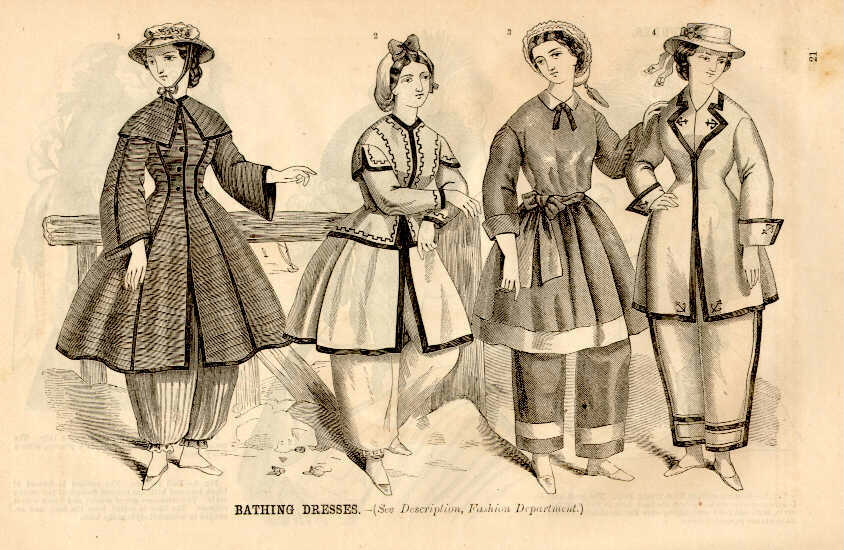
These are WOOL. They were made to go IN THE WATER.

My friend Tea has read that while they were designing these proto-swim suits, they were considering putting lead in the hems to keep the skirts from billowing up in the water. LEAD.

This fashion plate is from July 1864. Did anyone actually swim in these? I'm not sure. I've never seen a photograph of one in use, not to say there isn't documentation out there somewhere. I have a feeling these were more for the rich and leisurely to lounge about the beaches in some cosmopolitan area. Like New York. Or Cleveland, for that matter.

If anyone has anymore info on mid-century 'bathing' practices, I'd be curious to hear.

Sarah Josepha Hale Thinks You Have no Sense of Fashion

Although the face of beauty changes, the pressure to attain that perfect beauty does not.In a time without the proliferation of communication that we have today, ladies had one primary source for thier fashion and social guidance: Godey's. Godey's Ladies Book was the Vogue magazine of the 19th century. Godey's had the same far reaching influence and it's editor the same power of an Anna Wintour.


Here is a qoute from Mark Twain's Life on the Mississippi (1850):


"...The chaste and innocuous Godey's 'Lady's Book,' with painted fashion-plate of wax-figure women with mouths all alike—lips and eyelids the same size—each five-foot woman with a two-inch wedge sticking from under her dress and letting-on to be half of her foot."

I think that's hilarious.

Murder and Mayhem at Astor Place


One of the things that inspired me to start writing again was this post:

The Starbucks Place Riot

I love places where you can feel layers of history coming together. I love the fact that I can sit in the Starbucks at Astor place, sip on my Chai Latte, and think on what was probably the bloodiest Macbeth-instigated riot to date.

The Past Retold: Travel

I’ve been thinking…History has been known to repeat itself. And maybe the present is really just the past retold again and again with a different cast and a few set and costume changes.

For example, I hate airports. I hate to fly. I hate the recycled air that blows on you from that ridiculous circular vent above your head. The cramped space sitting next to a stranger, the hours of waiting, the way the change in air pressure makes your ears pop, and the hassle of going through security. I hate the engine noise on the plane, the fact that you only get a ½ ounce of peanuts with a ½ cup of water for a snack, and the nausea I feel within 30 seconds of take-off. It’s relatively expensive, and leaves you feeling exhausted, dirty, and sore. It’s boring if you’re traveling alone, and I can’t read (because of the nausea) I can’t listen to music because the engine noise is too loud and there’s all that fluid in my ears that refuses to pop, and if I take a Dramamine I fall asleep for the next 48 hours. Not to mention that there’s nothing to look at except for clouds or if you’re lucky the geometric shapes drawn by the city’s roads, housing developments, and farms thousands of feet below. The list goes on and on; suffice it to say, I hate to fly.

Which brings us to railway cars. There were many people who were less than impressed with the railroad when it first started to make its way into mainstream 19th century travel. After all, it was loud, uncomfortable and dirty; steam engines traveling at 25 miles an hour kicked up a lot of dust and soot. And the waiting. What was 3 o’clock in one town, might be 2:34 in another. It wasn’t until locomotive travel gained popularity that a more standardized time was established in cities around the country. The food was awful and the journey was bumpy and arduous. Women were advised not to travel alone, and guidelines were published in the unfortunate event that she was left sitting next to an odd gentleman who wanted to talk. It was bumpy, and there were patterns published in fashion magazines for bonnet covers to keep them from getting soiled from the soot. The railroad was expensive, yet compared to the alternative it was fast. So fast in fact, that people started to worry life was moving at too quick a pace.

So….as I mentioned before, I hate to fly, but I can get from Cleveland to New York City, for example, in an hour and a half rather than 10 hours by car. On a cloudy day I can’t see the ground, let alone the countryside, but it saves me time. And in a similar scenario a few years previous, a 19th century lady chose the railroad in lieu of a serene canal boat ride traveling at 3 miles an hour. The railroad was faster, and it saved her time even though she complained it was too loud, she had to sit next to a stranger, and the velocity with which the cars moved made it impossible for her to see the countryside.