Showing posts with label historic site. Show all posts

The Most Beautiful Suicide and a Traveling House

I've been so preoccupied with other projects that I haven't had time to share a few links that have come across my desk:


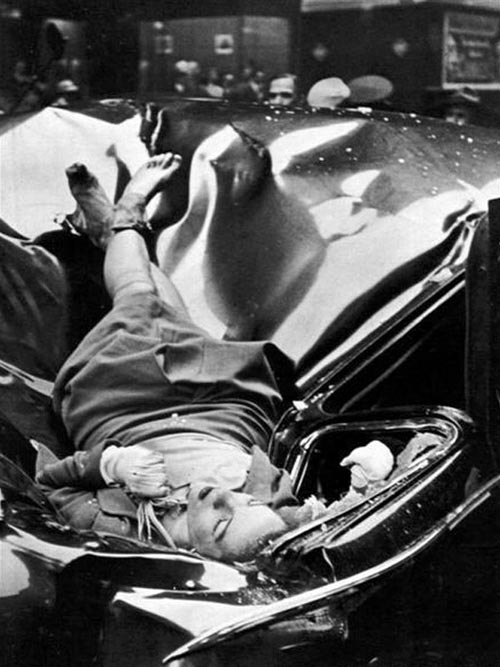
The most beautiful suicide, a photograph of a woman who jumped from the Empire State building in 1947.

In the same line, L'Inconnue, an unidentified woman who was found dead in the Seine. People found her visage so beautiful, that it became a fashion to hang her death mask on the parlour wall.

And finally, Ulysses S. Grant's birthplace toured the country following his death.

Would Anyone Like to Go Urban Camping? (A Brief History of Roosevelt Island)

I live near Roosevelt Island, a strip of land in the middle of the East River, between Manhattan and Queens. The Island has a rather rich an sordid history: at one time, built upon its grounds was a prison, a workhouse, an almshouse, a small-pox hospital, and an insane asylum. The latter was made famous by New York World reporter Nellie Bly. In an 1887 article, she went undercover as an insane woman to expose ill-treatment of the asylum's inmates. Today, the asylum building is a luxury condo.

You can see Roosevelt Island's various institutions in this 1903 Edison film. Also note that you can see the Queensborough Bridge in the process of being built--neat!


The Smallpox Hospital, on the south end of the island, still exists. After the smallpox epidemic was over, the building opened as a Nurse's School which closed its doors in the 1950s. The building has been abandoned since, and it's ruins are dramatically lit by the same lighting designer that illuminated the Statue of Liberty. You can get a good view of it from the Manhattan shoreline on the FDR.


I was fortunate enough to see the ruins up close. In 2008, Open House New York opened up South Point, the overgrown swath of land surrounding the ruins that has tentative plans to be turned into a park. Currently, it's locked up for all but special events. What's wonderful about South Point is that it feels wild--and it is. Unlike Olmstead's carefully constructed vision for Central Park, South Point is nature built from neglect. Walking through its center on a warm October evening, I could neither hear nor see the city. Woods open up to a grassy lawn, with breathtaking views of Manhattan and Queens on either side.

The space is ripe for an Urban Camping expedition.

I first went Urban Camping in Cleveland, on an empty lot on the city's west side that was once a teeming Civil War hospital. I wanted to draw attention to the neglected patch of land and increase the neighborhood's awareness of the history that took place on that unassuming lot. Myself and six friends camped out overnight: we built a campfire, cooked dinner and breakfast, told stories, played music. It felt positively rural--but all we had to do was look up to see Cleveland's gleaming skyline. Late in the night we were treated to a sky full of fireworks over Jacob's Field.

Southpoint is just right for the second installment of Urban Camping. The combination of the rural and urban is intoxicating. And the area has a rich history--in fact, in the Southpoint area quarantined smallpox victims were cared for in what Resident Physician William Kelly described as "a pile of poor wooden out houses on the banks of the river."

So would anyone be interested in joining me this summer? Additionally, is their anyone in the know who can recommend someone I can talk to about getting permissions for such an event? I'm going to put together a proposal this Spring.

Camp Out at Camp Cleveland (Urban Camping)- Tremont paper Article

Urban Camping Video

The Roosevelt Island Historical Society

Ghosts of Gettysburg

I used to work in one of the most haunted houses in Ohio, and never once encountered a ghost. Which to be truthful, is a bit of a disappointment.

I don't believe in ghosts, but it seems as though history and ghost hunting are inseparably linked. Sometimes, I feel as though Ghosts become a selling point for historic sites. For example, Gettysburg unashamedly offers nightly ghost tours, and I feel this walks a fine line in disrespecting those who died there.

However, a friend of mine sent me a link to a You Tube video of a Gettysburg ghost, and from there I found more and more videos of Civil War specters. So in the spirit of fun, take a look, and see what you think:


The best shot of the apparition appears at :23. The first time it appears at :13 is definitely a lightening bug. After that, it appears to be headlights on the trees.

This ghost appears to be on the car's windshield.

This one is at Manassas:


This is a video from The Montel Williams show, and it brings to mind the story of the haunting caused by carbon monoxide. The home video looks like it could be lens flare.

I was once told that ghosts only appear to those who want to believe in them. What do you think? Have you had any ghostly encounters at Historic Sites? Please share!

Happy Evacuation Day!

Today was an actual holiday, once more popular than the 4th of July, celebrating the day the British pulled out of New York City during the Revolutionary War.

This year was the 225th anniversary. And I missed it!!!! I had no idea it was going on. There were costumed reenactors!!! From the Minneapolis Star Tribune:

"A private reenactors group, the Brigade of the American Revolution, prepared a mock ceremony in which a British officer would give the key to New York City to one of Washington's officers.

That didn't actually happen in 1783, but the little drama was intended to symbolize the transfer of power that ended the Revolutionary War, two years after Washington's victory at Yorktown, Va., said park service spokesman Michael Callahan."

I love seeing things reenacted that never happened! Oh well...maybe next year.

Also, there are some commemorative lights in Jersey tonight, marking important Revolutionary War sites, including Fort Nonsense.


NYC Marks Evacuation Day (Minn. Star Tribune)


Make Gertrude Tredwell your Facebook Friend!


Recently, I visited the Merchant's House Museum on East 4th street here in New York. The house, built in 1832, is exceptional because it contains all of the original furnishings and possessions of the family that lived there for almost 100 years. How can such a thing happen? Well, the mother and father of the family both died in the 1860s; the three youngest daughters, unmarried, lived out the rest of their lives in the home, and never changed a thing after their parent's death. The beds had been moved in to the bedrooms the in 30's and had never moved again.

That is a little weird, right?

Gertrude, the youngest daughter, died in the 1930s. The house was recognized for the time capsule that it is and was almost immediately purchased and opened to the public.


I had been at the museum once before, at a funeral reenactment several Halloweens ago. They upped the anty on other funeral reenactments I had seen by including a wax corpse.


Additionally, should you visit, take note of the house next door.

"If there is a three-dimensional, bricks-and-mortar definition of forlorn, it is the abandoned Samuel Tredwell Skidmore House, which has stood at 37 East Fourth Street since 1845 - ever more tenuously in recent years.

"This sorry state is no accident...but rather a result of deliberate "demolition by neglect" by the owner, identified as the estate of Sol Goldman.

"What makes the decay of the Skidmore House so striking is the existence just 75 feet away, at 29 East Fourth Street, of the Merchant's House Museum, an exquisitely maintained landmark that was built in 1832 and occupied three years later by Seabury Tredwell, Skidmore's cousin once removed, and his large family.

"Margaret Halsey Gardiner, the executive director of the Merchant's House Museum, says she has watched despairingly as the neighboring Skidmore House fell apart. Occasionally, she got inside.

"In the early 1990's, she said, the house was still "manageably reparable" and possessed a remarkable number of 19th-century features: shutters, doorjambs, doorknobs, floorboards, a stairway balustrade with newel post and a lantern in the front hall.

"With each passing year and each fire and each wall collapse, she said, more of these elements vanished, some carted off by workers, some appropriated by neighbors.

"The heartbreaking final straw, Ms. Gardiner said, was the disappearance five or six months ago of the original bell pull at the front door. It still said "Skidmore," 123 years after Samuel Tredwell Skidmore died in that house.

" 'Skidmore,' " she marveled. " 'Skidmore!' There it was.

"'I should have stolen it myself.'"

Read the full New York Times article; a ruling was made in 2004 that the owner must preserve the Skidmore house, a historical landmark, but it still looks like shit.

Gettysburg: Bloodshed and Snickerdoodles


Gettysburg is filled with a lot of kitch, including more wax museums than I've ever seen in one place. I recommend heading straight to the Gettysburg National Military Park and the brand new visitor's center and museum.

There has been a lot of controversy about how the history of the civil war should be taught at Nation Park sites. Up until recently, battle sites taught only the military history of the war, not the social and political situation surrounding it. This was in deference to Southerners who thought a Nothern account of the war would be biased and offensive.

Recently, under the guidance of a new director, the National Park has begun to paint a picture of the war as a whole, (South be damned). The new Gettysburg Visitor Center is one of the first steps in this new direction. (I read about this in a U.S News Special Report: Secret of the Civil War article over the summer. Unfortunately, I can't find the article online, so I hope I am correctly paraphrasing.)

I found the museum to be excellent. It was filled with personal artifacts, quotes, and stories that allowed you to connect with the history on a human level. One understands not just the battles of the war, but how the war came to be.

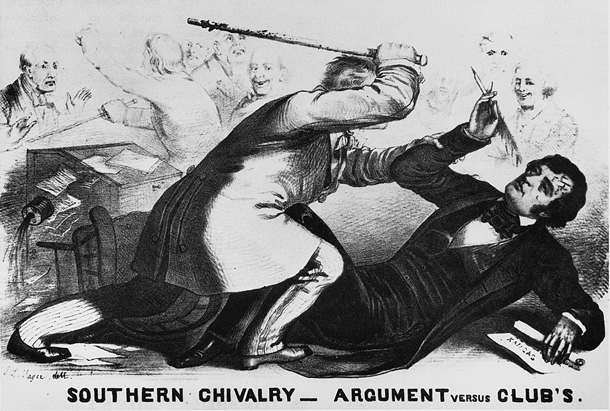
The most horrible new thing I learned was the story of Senator Charles Sumner, who in 1856:

"...Delivered a speech opposing the spread of slavery and mocking Southern slaveholders. Two days later, Rep. Preston Brooks of South Carolina walked into the chamber and beat Sumner unconscious with his cane."

Sumner was crippled for the rest of his life. Brooks, who broke his cane during the attack, was sent replacement canes by Southerners sympathetic to his cause.


One of the nicest touches at the Visitor's Center was a recreated "Refreshment Saloon." During war time, it was a volunteer-run mess hall for soldiers. In this modern Refreshment Saloon, they had all the usual lunchtime fair, but also had a menu of period appropriate food. My mom and I had roasted peanut soup with hard tack, and an order of Pennsylvania Pot Pie with cornbread, and a snickerdoodle for dessert. Delicious and accurate!

The National Park offers both a podcast of battle tours, and a map for a driving tour. I recommend paying the money for a bus tour with a licensed guide. The combination of standing on the ground where the battle took place, holding a map of the troop movements, and having someone explaining it step-by-step allowed me to finally understand the magnitude of what happened at Gettysburg.

Gettysburg National Military Park


Gettysburg: Where HISTORY Lives and the fun never ends


I went to Gettysburg recently. It was fucking depressing. As well it should be: over 50,000 American were lost, wounded or killed at Gettysburg. Between 600,000-700,000 men died during the entirety of the war, which is more than the Revolutionary War, The Mexican-American War, the War of 1812, WWI, WWII, and the Korean War COMBINED.

But in case you ever had any doubt about heading to the 'Burg yourself, I wanted to share with you these images from the 2008 Official Visitors Guide.


...place to relax!


a unique shopping experience...


finding a memorable dining experience...